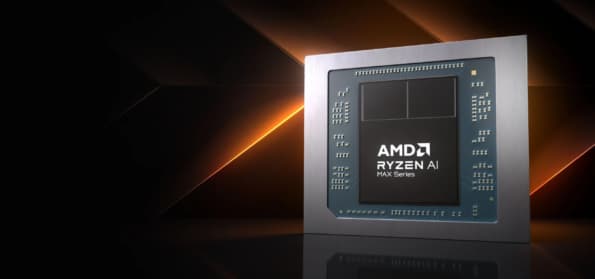
The AMD Strix Halo is being hailed as the most powerful chip ever made for mini PCs. We tell you everything you need to know about Strix Halo mini PCs.
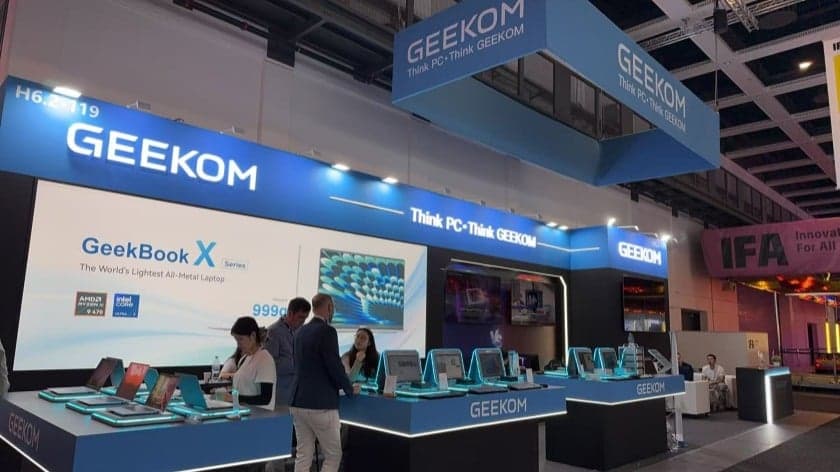
Back in December 2024, chip manufacturer AMD unveiled what may be the biggest innovation in the mini PC niche with the Strix Halo—even though it was originally intended for notebooks. At IFA 2025, the about-turn finally followed, along with the announcement that the processor would be built into the first mini PCs.
The AMD Strix Halo isn’t just a physically large processor — it also delivers on a grand scale technically. Especially in the gaming and AI fields, it’s set to leave a lasting impression.
In this article, we break down in detail what makes the AMD Strix Halo special, who should consider purchasing the new processor, and how GEEKOM is entering the Strix Halo market in the UK.
Quick Answer: Is AMD Strix Halo Worth It in 2026?
Yes — for the right user. The AMD Strix Halo (Ryzen AI Max+ 395) is the most capable chip you can currently fit in a mini PC, pairing 16 Zen 5 cores with desktop-class Radeon 8060S graphics, a 50 TOPS NPU, and up to 128GB of unified memory. It’s ideal for creators, local AI users, and demanding all-rounders—but overkill for basic office work.
AMD Strix Halo at a Glance (Ryzen AI Max+ 395) CPU 16 cores / 32 threads, Zen 5 Integrated GPU Radeon 8060S (RDNA 3.5, 40 CUs) — desktop-class NPU XDNA 2, up to 50 TOPS — Copilot+ ready Memory Up to 128GB unified LPDDR5X — runs large local LLMs Best for Creators, local-AI workloads, high-end all-rounders Skip if You only need email, browsing and office apps
What Is AMD Strix Halo?
The AMD Strix Halo is an APU (Accelerated Processing Unit) that was first announced in December 2024. Originally, the new processor was intended for use in notebooks, but since IFA 2025, it’s been clear that the Strix Halo will mainly find its place in mini PCs.
The AMD Strix Halo is a high-end APU architecture that combines CPU, GPU and NPU on a single chip. While it’s marketed as Strix Halo, the actual chips can be found in the variants Ryzen AI Max Pro 380, Ryzen AI Max 385, Ryzen AI Max Pro 390, and Ryzen AI Max+ 395.
The Strix Halo is built on Zen 5 architecture, with up to 16 cores (32 threads), up to 5.1 GHz, an integrated Radeon 8060S RDNA 3.5 graphics unit with 40 cores, 50 TOPS, and a power dissipation of up to 120 watts. On top of that, the APU comes with integrated working memory of up to 128 GB of RAM.
Zen 5 & RDNA 3.5 — Architecture Explained Simply
A note on terminology. To understand how good the AMD Strix Halo really is, you need to understand what the architecture of the new mega-processor is all about:
Strix Halo, Ryzen AI Max & “Ryzen AI Max+” — Naming Decoded
If you’ve been shopping for a Strix Halo mini PC, you’ve likely seen three different names used almost interchangeably. They aren’t the same thing—here’s how they fit together.
Strix Halo is AMD’s internal codename for the chip itself. You’ll see it in reviews and leaks, but it never appears on the retail box.
Ryzen AI Max is the actual product name AMD sells these chips under—specifically the Ryzen AI Max 300 series (the AI Max 395, 390, and 385). So every Ryzen AI Max 300 chip is a Strix Halo; “Strix Halo” is simply the engineering name behind the branding.
The “+” in Ryzen AI Max+ marks the top-tier variant. The flagship 395 wears the Ryzen AI Max**+** badge, while the lower-clocked 390 and 385 are plain Ryzen AI Max—the plus is AMD’s way of flagging its most powerful configuration.
Finally, Ryzen AI is the broad umbrella brand covering all of AMD’s AI-capable processors, not just Strix Halo. A thin-and-light laptop chip like the Ryzen AI 9 HX 370 (codenamed Strix Point) is also “Ryzen AI”—it just isn’t a Strix Halo. In short: Strix Halo is a subset of the wider Ryzen AI family, sold as Ryzen AI Max.
All Strix Halo Processors at a Glance: AI Max 395, 390, 385 & Co.
| Model | Configuration | Architecture | Graphics Unit | Power (Watt) | NPU (TOPS) |
|---|---|---|---|---|---|
| Ryzen AI Max Pro 380 | Zen 5 (6/12) | RDNA 3.5 | Radeon 8040S, 16 cores | 45–120 | 50 |
| Ryzen AI Max Pro 385 | Zen 5 (8/16) | RDNA 3.5 | Radeon 8050S, 32 cores | 45–120 | 50 |
| Ryzen AI Max Pro 390 | Zen 5 (12/24) | RDNA 3.5 | Radeon 8050S, 32 cores | 45–120 | 50 |
| Ryzen AI Max+ Pro 395 | Zen 5 (16/32) | RDNA 3.5 | Radeon 8060S, 40 cores | 45–120 | 50 |
Strix Halo vs. Strix Point — What’s the Difference?
Watch out—easily confused. Despite the similar name, the AMD Strix Halo is NOT the same as the AMD Strix Point. While the two AMD products share some commonalities — such as the Zen 5 architecture and the Radeon graphics unit with RDNA 3.5 — they differ in other respects.
While the Strix Halo is intended for use in mini PCs, the Strix Point has established itself as a processor for thin notebooks. Consequently, Strix Halo outpaces its “smaller” predecessor in several specifications that enable higher desktop-class performance. That makes Strix Halo a pro solution “on steroids”, while Strix Point is somewhat more mass-market friendly (and more affordable).
What Makes Strix Halo Special in a Mini PC?
By now you’ll have understood that the AMD Strix Halo is an absolute performance monster in the mini PC space, capable of taking on full-fledged desktop PCs and even consoles. But aside from the raw numbers and facts, what actually makes Strix Halo special?
Integrated GPU Performance at Desktop Level
As an APU, Strix Halo combines CPU and GPU in a single unit — meaning you don’t need an additional graphics card — yet it can still hold its own against demanding desktop PCs. The integrated Radeon graphics unit uses RDNA 3.5 architecture with up to 40 cores, making it perfectly suited to intensive mini PC gaming.
50+ TOPS NPU & Copilot+ PC — Local AI Without the Cloud
Strix Halo includes a dedicated XDNA 2 NPU rated at up to 50 TOPS — comfortably clearing the 40 TOPS threshold Microsoft requires for a Copilot+ PC. The NPU is a separate engine built purely for AI tasks, so it handles them efficiently without loading the CPU or GPU.
The practical benefit is on-device AI features, such as live captions, image generation and Copilot+ tools, run locally, keeping your data on the machine rather than sending it to the cloud. For privacy-conscious users and anyone working offline, that’s a meaningful advantage over cloud-dependent alternatives — and it runs at low power, so it doesn’t drive up fan noise or heat.
Up to 128GB Unified Memory — Running Large Local LLMs
This is Strix Halo’s most distinctive capability. Its unified memory architecture lets the CPU, GPU and NPU share a single pool of up to 128GB LPDDR5X, with a large share assignable to the graphics — far beyond the fixed, limited VRAM of a normal integrated GPU.
For local AI, that changes what’s possible. Large language models are constrained mainly by available memory, so a generous unified pool lets Strix Halo load and run sizeable models entirely on-device — work that would otherwise demand an expensive discrete GPU with lots of VRAM. Combined with the NPU and Radeon 8060S, it makes a Strix Halo mini PC a credible, compact platform for serious local-AI experimentation.
Strix Halo Mini PC Performance in Practice
In practice, Strix Halo mini PCs are likely to establish themselves above all for gaming, AI applications and professional workloads—particularly when it comes to handhelds and mobile setups. For these use cases, the purchase of a Strix Halo mini PC makes sense:
Gaming at 1080p and 1440p — What’s Realistic?
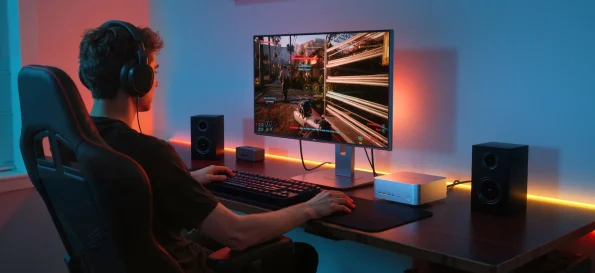
Strix Halo mini PCs enable smooth gameplay at 1080p and 1440p with their integrated graphics card, at the same level as mid-range gaming PCs with dedicated graphics cards.
For maximum gaming performance, however, the full output of up to 120 W is required. That puts a mini PC properly through its paces. Under sustained high load, a Strix Halo mini PC can chew through your battery in under an hour.
Strix Halo is a great solution for playing demanding AAA titles on a portable setup. That said, Strix Halo doesn’t replace a high-end desktop gaming PC.
Content Creation, 3D Rendering & Productive Workloads
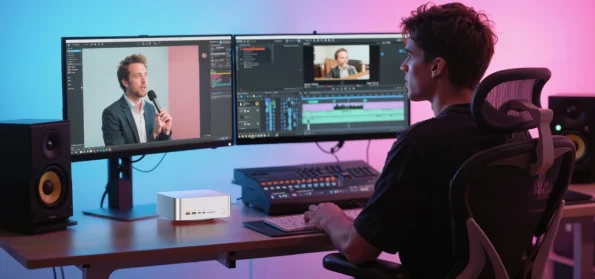
Even though Strix Halo was initially presented with a strong AI pivot, with an NPU of 50 TOPS, it’s more in the upper mid-tier or lower high-end range of AI performance.
Yes—the large integrated working memory of 128 GB of RAM is a plus for running large AI applications. Nevertheless, Strix Halo Mini PCs eventually reach their limits with image generation and 3D rendering. Should that happen, the lack of scaling options means you’ll also hit a ceiling fairly quickly.
How Does Strix Halo Compare?
Strix Halo doesn’t really compete with other mini-PC chips — it competes with the high-end silicon in premium laptops and small workstations. The two comparisons that matter most are Intel’s Core Ultra Series 2 and Apple’s M4 Pro / Max.
Strix Halo vs Intel Core Ultra (Series 2)
The short version: Strix Halo wins decisively on integrated graphics and local-AI memory, whilst Intel’s Core Ultra Series 2 (Lunar Lake) leads on efficiency in thin, battery-powered designs. In a mains-powered mini PC — where battery life is irrelevant — Strix Halo is the stronger all-round choice.
The gap is widest on graphics: the Radeon 8060S is in a different class from Intel’s Arc integrated GPU, making Strix Halo far better suited to gaming and GPU-accelerated creative work. Both platforms clear the Copilot+ NPU threshold, so on-device AI features work either way — but Strix Halo’s unified-memory design lets it load much larger local models than a typical Core Ultra system. Intel’s advantage is power draw and idle efficiency, which matters more in a laptop than in a mini PC that stays plugged in.
| Strix Halo (Ryzen AI Max+ 395) | Intel Core Ultra (Series 2) | |
|---|---|---|
| Integrated GPU | Radeon 8060S — desktop-class | Intel Arc — mainstream |
| Local AI (memory) | Up to 128GB unified — large LLMs | Lower memory ceiling |
| Copilot+ NPU | Yes | Yes |
| Power efficiency | Higher power draw | Class-leading efficiency |
| Best in a… | Mains-powered mini PC | Thin, battery-first laptop |
Strix Halo vs Apple M4 Pro / Max
The short version: Apple’s M4 Pro and M4 Max lead on power efficiency, single-core speed and sustained performance per watt, whilst Strix Halo wins on price, gaming and open-platform flexibility. For Windows users who want desktop-class graphics and local AI without Apple’s premium, Strix Halo is the more practical pick.
Both share the same core idea — a large unified-memory pool feeding CPU, GPU and AI accelerators — which is why they’re compared so often for local LLM work. The M4 Max can be configured with even more memory bandwidth and generally does more per watt, but only inside macOS and at a notably higher price. Strix Halo runs Windows (and Linux), plays PC games natively, and typically undercuts an equivalently specced Mac, making it the better value for gaming and mixed workloads. If your workflow lives in macOS, Apple remains the natural choice.
| Strix Halo (Ryzen AI Max+ 395) | Apple M4 Pro / Max | |
|---|---|---|
| Platform | Windows / Linux — open | macOS only |
| PC gaming | Native, strong | Limited |
| Efficiency / perf-per-watt | Good | Class-leading |
| Local LLMs | Up to 128GB unified | High-bandwidth unified |
| Value | Lower cost for the spec | Premium pricing |
GEEKOM A9 MEGA — Our Strix Halo Mini PC with AMD Ryzen AI Max+ 395
After early rumours, since IFA 2025 we’ve had certainty about another welcome piece of news. At IFA 2025 in Berlin, the Taiwanese mini PC manufacturer GEEKOM announced that it would soon also be launching a Strix Halo mini PC.
The GEEKOM A9 Mega is set to become the new flagship of the mini PC brand and is already available through the official GEEKOM Australia store. But let’s start from the beginning:
First Unveiled at IFA 2025 — GEEKOM’s Strix Halo Launch
After AMD had confirmed in the lead-up to IFA 2025 that Strix Halo would establish itself primarily as a solution for mini PCs rather than for notebooks as previously assumed, GEEKOM raised the stakes a few days later.
From 5 to 9 September 2025, the Taiwanese PC manufacturer used its trade show stand in Hall 5.2b to put its latest, groundbreaking innovation centre stage: the GEEKOM A9 Mega—a powerful Ryzen™ AI Max+ 395 Mini PC for demanding workloads.
The latest release from GEEKOM’s mini PC line-up is set to be nothing less than the world’s most powerful AI mini PC. That’s a big promise — but not an impossible one. After all, the new AI Mini PC will be powered by the best mobile chip the market has to offer: the Ryzen AI Max+ 395.
On top of already first-class specifications—Zen 5 architecture, Radeon GPU with RDNA 3.5 and 50 AI TOPS—GEEKOM delivers a chassis that’s set to delight professionals and creative minds alike, and that’s also perfectly suited to AAA gaming.
Technical Specifications, Ports & Highlights
The GEEKOM A9 Mega leans on features that get the most out of the Ryzen AI Max+ 395 chip, skilfully playing to its strengths—and its weaknesses. Here’s an overview of the most important software and hardware data:
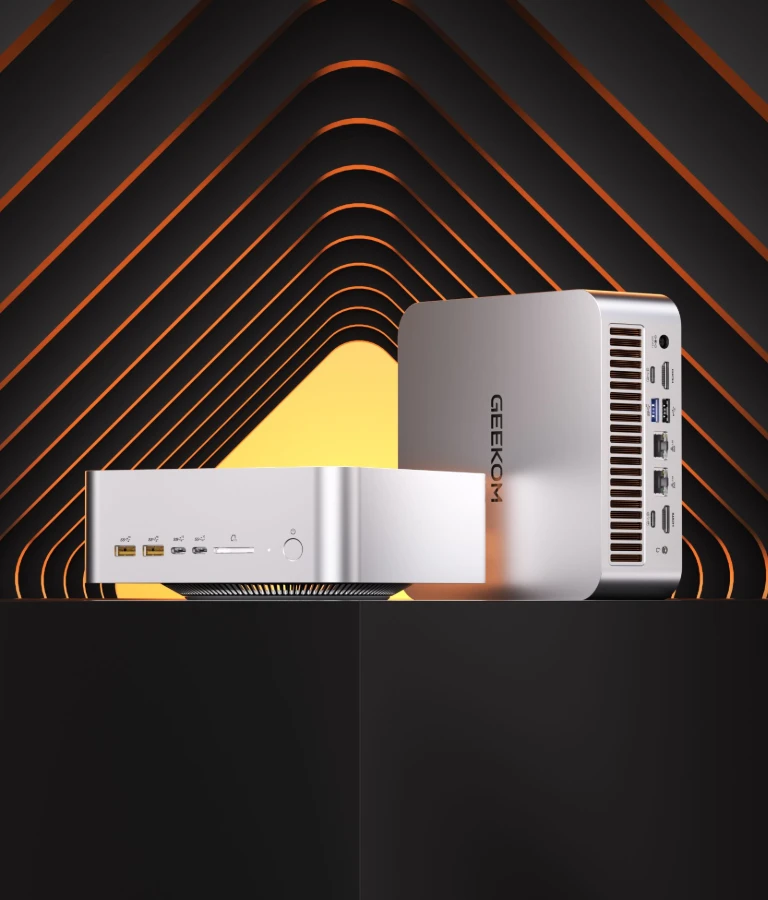
- 126 TOPS AI Power with AMD Ryzen™ AI Max+ 395
- IceBlast 5.0 Cooling for stable 120W performance
- 330W PSU for reliable peak workloads
- Up to 128GB RAM + 8TB SSD with RAID support
- Supports up to four 8K displays
- Aluminium chassis with Wi-Fi 7 and dual 2.5G LAN
These first-class specifications are packed into an aviation-grade aluminium alloy that, at dimensions of 171 × 171 × 70.9 mm, is only slightly larger than the palm of your hand and fits on virtually any work surface.
Who Is an AMD Strix Halo Mini PC Really Worth It For?
An AMD Strix Halo mini pc is a genuine powerhouse. In many respects — professional workflows, AI applications and gaming — mini PCs like the GEEKOM A9 Mega can comfortably keep up with professional desktop PCs. But that doesn’t apply without qualification.
Home Office, Gaming or Content Creation — Which is the Right Choice?
Looking for a better AI desktop PC? You’ll find one. Looking for a better gaming desktop PC? You’ll find that too.
The ambition of a Strix Halo mini PC, however, isn’t to beat professional desktop setups. Rather, it aims to put the best mobile chip of all time exactly where it shines best — on the move.
An AMD Strix Halo mini PC is an all-rounder that supports professionals and creative minds with demanding workflows and recurring AI projects in their day-to-day work — and even after hours, it shows no weakness when it comes to AAA gaming.
It’s a mobile solution that lets you combine home office, content creation and gaming under one roof, without having to worry about specifications, expansions or storage space.
When Is a Strix Halo Mini PC Too Much — and When Too Little?
The price tag of the GEEKOM A9 Mega is already a not-so-subtle hint. Not everyone needs an AMD Strix Halo mini pc. For many, it’ll quite simply be overkill.
If your daily work doesn’t regularly involve editing photos, cutting video, creating 3D renders or running AI experiments, then a mid-range mini PC like the GEEKOM A9 Max will likely already be enough.
If, on the other hand, you need a specialised solution for particularly demanding AI workloads, or you’re looking for the best possible gaming PC, you’ll be better served by other solutions that focus exclusively on those areas.
A Strix Halo mini PC like the GEEKOM A9 Mega is the ideal solution when it brings together professional content creation, AI applications and gaming in a dynamic environment.
Conclusion — Is an AMD Strix Halo Mini PC Worth It?
Yes, an AMD Strix Halo mini PC is worth it — provided you know how to use it correctly. The new AMD chip series codenamed Strix Halo delivers four high-performance APUs (Ryzen AI Max Pro 380, Ryzen AI Max 385, Ryzen AI Max Pro 390 and Ryzen AI Max+ 395), which can rightly call themselves the best mobile chips of all time.
New mini PCs like the GEEKOM A9 Mega lift the capabilities of professional mini PCs to a previously unknown level with the help of Zen 5 architecture and an integrated RDNA 3.5 graphics unit, opening up entirely new possibilities for mobile professionals.
Their ambition isn’t to be the best stationary AI machine or the best stationary gaming setup. Those spots are filled by other solutions. AMD Strix Halo mini PCs convince by bringing top-tier performance to every workspace – no matter how much room you have in your bag or on your desk. For Australian buyers in particular, that compact form factor pairs well with the realities of home offices, studios and co-working spaces from Sydney to Perth.
FAQ
What does Strix Halo mean?
Strix Halo is the codename for a new series of mobile AMD chips, hailed as the best mobile chips of all time. Specifically, it refers to the following four chips: Ryzen AI Max Pro 380, Ryzen AI Max 385, Ryzen AI Max Pro 390 and Ryzen AI Max+ 395.
Is AMD Strix Halo better than Intel Core Ultra?
The AMD Strix Halo and the Intel Core Ultra pursue different approaches. While the AMD Strix Halo is particularly good at unleashing peak performance on mini PCs, the Intel Core Ultra is tuned for productivity and energy efficiency in laptops.
What’s the difference between AMD AI Max 395 and 390?
The AMD Ryzen AI Max Pro 390 and AMD Ryzen AI Max+ 395 only have small technical differences. The AMD AI Max+ 395 outperforms the AMD AI Max Pro 390 with more cores and threads (16/32) and a better graphics unit — the Radeon 8060S with 40 cores.
Is Strix Halo the same as Ryzen AI?
Yes, Strix Halo is the codename for the AMD Ryzen AI Max series, a marketing name that rolls off the tongue a little more easily. Behind the Strix Halo name sit a total of four chips: Ryzen AI Max Pro 380, Ryzen AI Max 385, Ryzen AI Max Pro 390 and Ryzen AI Max+ 395.